
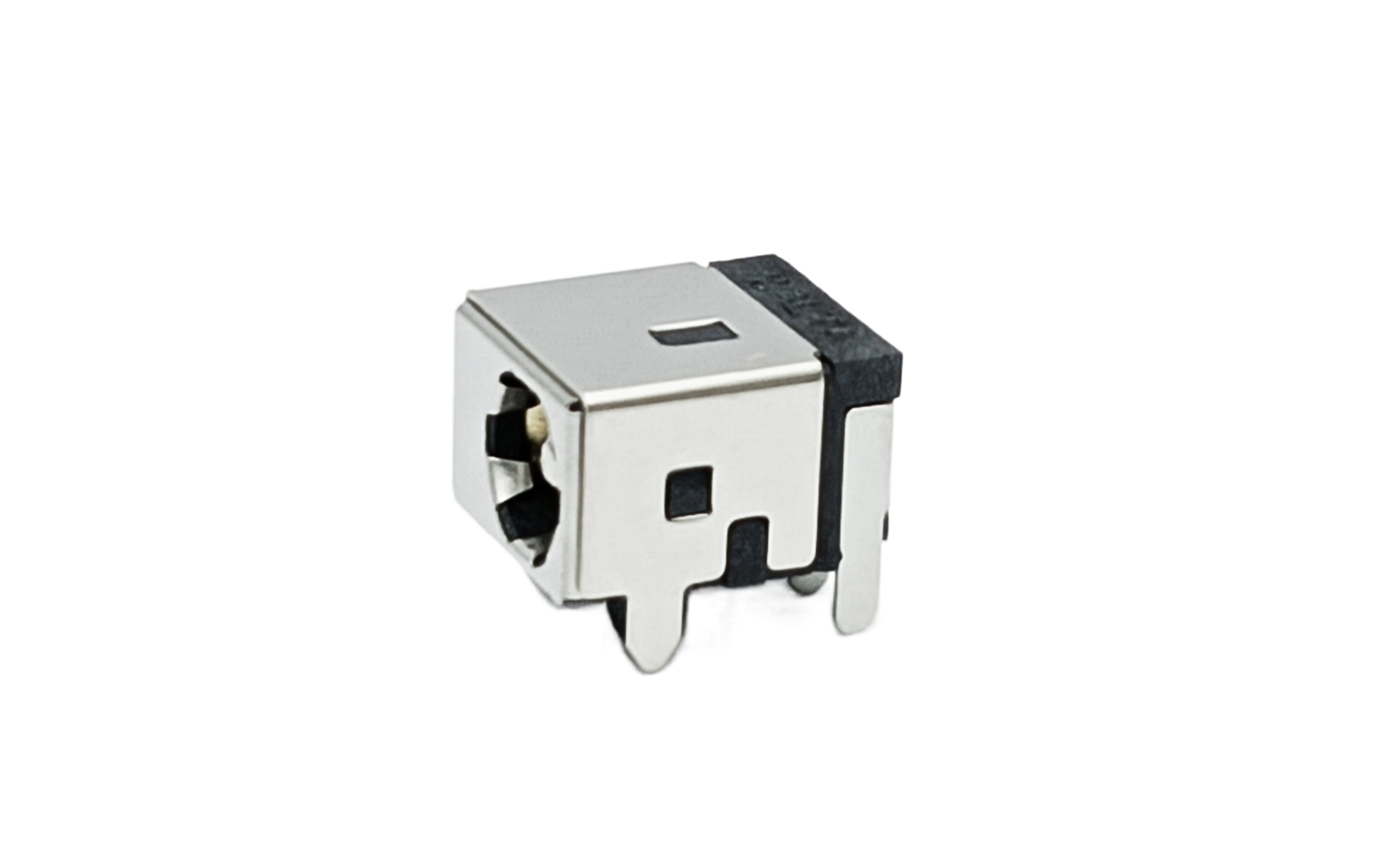
DC Power Jack selection requires checking the mating plug outer and inner diameters, rated voltage, rated current, polarity and mounting style. Ratings must be confirmed against the datasheet for each model.
Has a change of power adapter left you with a plug that will not fit the jack on the enclosure? Even if it fits, can the jack handle the electrical load? Jack selection must account for dimensions, voltage and current. None can be overlooked! Barrel DC Power Jacks may look similar but their ratings are not universal and must be checked against individual datasheets. This article covers selection in the order of dimensions, voltage and current, then polarity and mounting style, with comparison tables. Equipment using USB for power input requires a Micro USB Connector or USB Type-C Connector and is outside the scope of this article.
DC Power Jack Dimensions: Understanding Outer and Inner Diameters
DC Power Jack mating dimensions are usually expressed as the plug outer diameter × inner diameter in millimetres (mm). The outer diameter is measured across the outside of the plug barrel and the inner diameter across its central opening. In a conventional barrel jack, the centre contact diameter must fit the plug inner diameter with the intended design clearance; the two dimensions should not be assumed to be identical. Common combinations use a 5.5 mm plug outer diameter with either a 2.1 mm or 2.5 mm inner diameter. Different sizes should not be assumed to be interchangeable. Select the jack using the power adapter plug outer diameter, inner diameter and insertion length, then check the jack drawing and tolerances.
| Plug outer × inner diameter | Common use | Identification and selection points |
|---|---|---|
| 5.5 mm × 2.1 mm | Common general purpose size | Smaller centre contact; a 2.5 mm inner diameter plug may fit loosely and should not be substituted without confirmation |
| 5.5 mm × 2.5 mm | Alternative mating size with the same outer diameter as the 2.1 mm version | Larger centre contact; a 2.1 mm inner diameter plug will normally not fit |
| 3.5 mm × 1.35 mm | Common smaller size | Check current and voltage ratings in the datasheet; do not infer them from size alone |
| 4.0 mm × 1.7 mm | Common EIAJ-02 mating dimensions | EIAJ-02 compliant products correspond to the 3.15 V to 6.3 V class; dimensions alone do not establish compliance |
Round power jacks that look similar may still be mechanically or electrically incompatible. Check every dimension rather than the outer diameter alone. In particular, the 2.1 mm and 2.5 mm inner diameters differ by only 0.4 mm. The consequences of mixing them are covered in the frequently asked questions.
DC Power Jack Voltage and Current: Understanding the Ratings
There is no single voltage or current rating that applies to every DC Power Jack. Use the datasheet for the specific model; ratings cannot be inferred from the outer diameter. Japan’s EIAJ RC-5320A specification is an example of dimensions being assigned to voltage ranges. It defines five plug classes by operating voltage range, each with a standard rated current of 2 A. The selected model’s specifications and test conditions must still be checked.
| Class | Operating voltage range | Plug outer diameter | Plug inner diameter | Rated current |
|---|---|---|---|---|
| EIAJ-01 | 0 V to 3.15 V | 2.35 mm | 0.7 mm | 2 A |
| EIAJ-02 | 3.15 V to 6.3 V | 4.0 mm | 1.7 mm | 2 A |
| EIAJ-03 | 6.3 V to 10.5 V | 4.75 mm | 1.7 mm | 2 A |
| EIAJ-04 | 10.5 V to 13.5 V | 5.5 mm | 3.3 mm (also has a 1.0 mm centre contact) | 2 A |
| EIAJ-05 | 13.5 V to 18.0 V | 6.5 mm | 4.3 mm (also has a 1.4 mm centre contact) | 2 A |
Common nominal plug outer diameters for EIAJ-01 and EIAJ-03 are 2.35 mm and 4.75 mm respectively. Alternative dimensional descriptions should not be combined into a freely interchangeable size range. EIAJ-04 and EIAJ-05 plugs also contain a centre contact with a diameter of 1.0 mm and 1.4 mm respectively. The inner diameters in the table must not be mistaken for these centre contact diameters. Some supplier documents also show inner diameters of 3.4 mm and 4.4 mm. Check the complete mating drawings, tolerances and insertion length before purchasing.
General purpose barrel power jacks usually do not have this fixed relationship between size and voltage. Current ratings commonly include values from 1 A to 5 A, while specialised models can carry up to 11 A. Voltage ratings vary, with examples including 12 V and 24 V. Do not treat 12 V as a universal rating or 48 V as the maximum for all models. If the product information does not specify a rated voltage, confirm it with the manufacturer rather than assuming a suitable operating voltage.
Apply two checks: the jack’s rated voltage must be at least the highest voltage the power supply may output and its permissible current under the actual temperature and wiring conditions must be at least the equipment’s maximum input current. If either condition is not met, select another model. A matching outer diameter is not sufficient. Also confirm that the power supply output voltage meets the equipment’s input requirements. A higher jack voltage rating does not mean that the equipment can tolerate a higher voltage.
Polarity and Mounting Style: What Else Must Be Checked?
A common wiring arrangement for a DC Power Jack uses a positive centre contact and a negative outer sleeve. However, some equipment and power supplies use a negative centre contact. Polarity depends on the actual wiring and cannot be determined from the jack’s appearance alone. Reversed polarity may damage equipment circuitry, so check the polarity markings on both the equipment and power supply before connecting them.
The mounting style determines how the jack is secured to the product. Common options include through hole mounting, where contacts pass through the PCB before soldering, surface mounting and chassis or panel mounting. PCB versions also offer vertical and right angle mating orientations. Select these according to the plug insertion direction and enclosure opening rather than classifying them solely by contact appearance. Even when dimensions and ratings match, a jack cannot fit the same design if its mounting style or PCB pad and hole pattern differs.
Which Datasheet Fields Should You Check? A Selection Checklist
The main DC Power Jack datasheet fields include rated voltage, rated current, contact resistance, insulation resistance, dielectric withstand voltage, mating cycle life and operating temperature. Check each field to determine whether the model is suitable for the intended equipment.
| Datasheet field | How to interpret it |
|---|---|
| Rated voltage | Must be at least the highest possible power supply output voltage; a dielectric test voltage is not an operating rating |
| Rated current | Permissible current under the actual temperature and wiring conditions must be at least the equipment’s maximum input current |
| Contact resistance | At the same current, lower resistance means lower voltage drop and heat generation at the contact |
| Insulation resistance and dielectric withstand voltage | Verify insulation performance at the specified test points and conditions; dielectric test voltage is not a continuous operating voltage |
| Mating cycle life | Must cover the expected cycles; check test conditions and acceptance requirements after durability testing |
| Operating temperature | Must cover the actual operating environment; also check temperature rise under load and current derating conditions |
Contact resistance is also part of service life assessment. Evaluate mating cycle life against the specified cycle count, contact resistance limit or permitted increase and other applicable acceptance criteria such as insertion and withdrawal forces and mechanical integrity. Contact resistance alone is not sufficient and no fixed value applies to every model.
Frequently Asked Questions
Q: What happens if 2.1 mm and 2.5 mm DC plugs are mixed up?
A: DC plugs with 2.1 mm and 2.5 mm inner diameters should not be used interchangeably without confirmation. For plugs that both have a 5.5 mm outer diameter, the inner diameters differ by only 0.4 mm and are difficult to distinguish visually. A plug with a 2.1 mm inner diameter will normally not fit over the centre contact of a jack intended for a 2.5 mm plug. Conversely, a plug with a 2.5 mm inner diameter may fit into a jack intended for a 2.1 mm plug but excessive clearance can cause poor contact or intermittent power. Unless the manufacturer explicitly states compatibility, check the complete mating dimensions before purchasing rather than relying on appearance.
Q: What is the typical mating cycle life of a DC Power Jack?
A: Some DC Power Jack datasheets specify values such as 5,000 or 10,000 mating cycles. The number depends on the model, plating and contact design and must be considered together with the test conditions. For equipment that requires frequent power connection and disconnection, select a model whose life covers the expected number of cycles. Confirm that contact resistance, insertion and withdrawal forces and mechanical condition meet the specification after durability testing. The rated mating cycle count is not the number of cycles permitted under electrical load.
Q: Why does EIAJ use plug dimensions to distinguish voltage classes?
A: EIAJ uses plug dimensions to restrict which voltage classes can be connected. Its design principle is to supply higher voltages through larger plugs. A larger plug cannot enter a smaller jack, reducing the chance of connecting a higher voltage supply to equipment designed for a lower voltage.
DC Power Jack Selection Requires Checks of Dimensions, Voltage, Current and Polarity
DC Power Jack selection can be reduced to three checks: the plug and jack mating dimensions and insertion length must match; rated voltage and permissible current must meet the power supply and equipment requirements; and polarity and mounting style must suit the design. Each item must be supported by a datasheet or drawing. An identical outer diameter does not imply identical ratings.
Walta Electronic is a Connector Manufacturer in Taiwan. Please contact us by email or telephone if you need help confirming specifications when selecting a DC Power Jack. If existing models do not meet your requirements, Walta Electronic also serves as a Custom Connector Manufacturer, providing complete OEM/ODM support from product design, tooling development, prototyping and testing through to mass production.
Walta Electronic
Tel: 886-2-2657-7778
Email: inquiry@walta.com.tw
Address: 3F-2, No. 15, Lane 360, Section 1, Neihu Road, Neihu District, Taipei City, Taiwan