
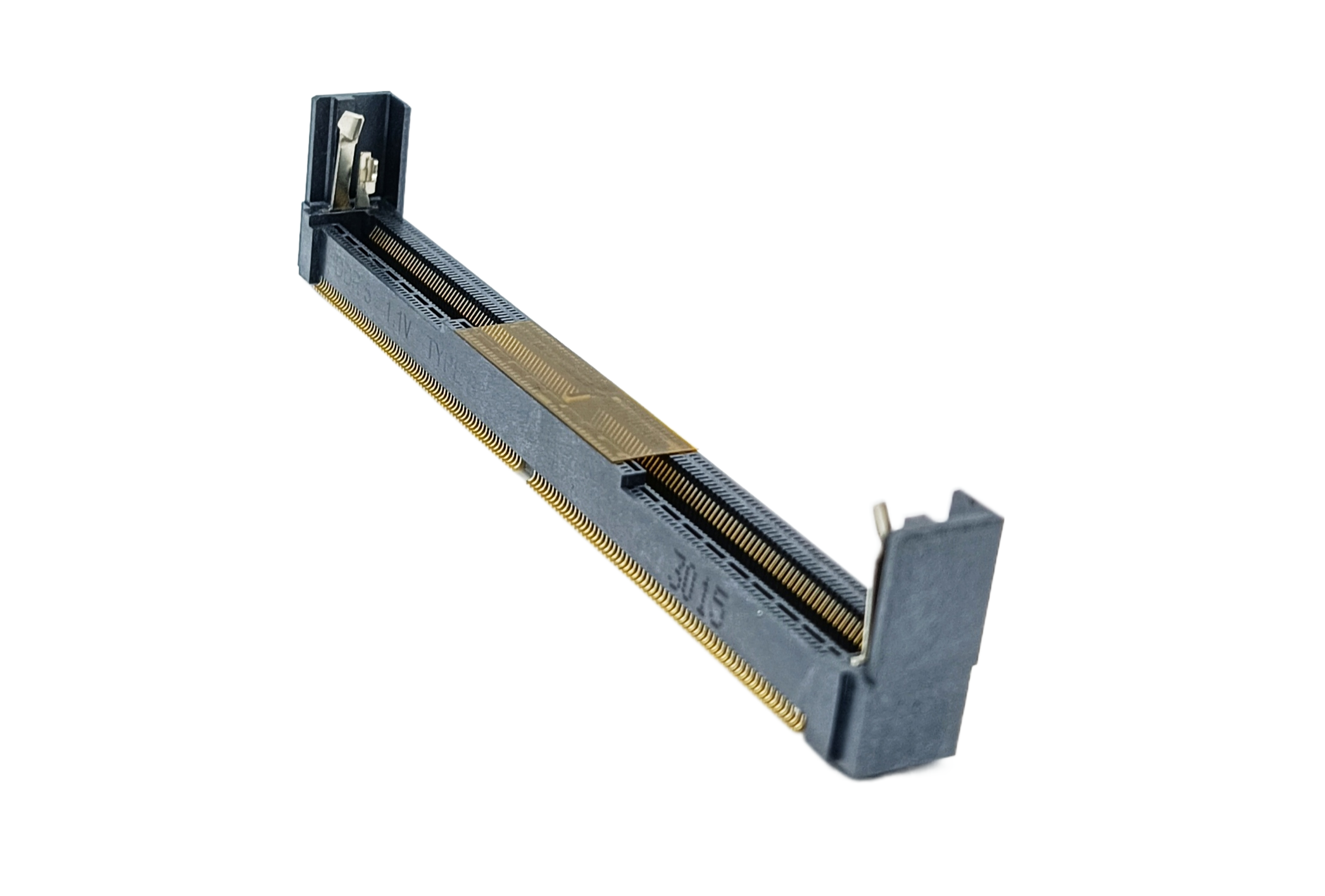
DDR4 Connectors and DDR5 Connectors are not interchangeable. Their module key notch positions, operating voltages and power architectures differ, preventing direct physical interchange.
If you are an engineer planning memory sockets or selecting connectors, you may have faced this question: with both DDR4 and DDR5 components on hand, can you use the same connector to save tooling and inventory costs? The answer is no. Understanding why they are incompatible and where they differ is worth a few minutes of your time.
Without a clear understanding of these differences, you may be concerned that selecting the wrong specification could leave an entire batch of components unusable. The following sections compare notch positions, operating voltages and power architectures so you can confirm the requirements before selecting a connector.
Can DDR4 Connectors and DDR5 Connectors Be Used Interchangeably? The Answer Is No
DDR4 Connectors and DDR5 Connectors are not interchangeable. Although their standard DIMM versions both have 288 contacts, the sockets and modules cannot be cross mated. This restriction is not a marketing distinction created by manufacturers. DDR4 and DDR5 modules that comply with JEDEC specifications have different key notch positions to prevent incorrect insertion mechanically. This reduces the risk of motherboard or memory damage if a user attempts to insert a DDR5 module into a DDR4 socket.
A common situation is a product line that needs to support both DDR4 and DDR5 platforms. In this case, connectors must be selected and stocked separately. A single connector cannot serve both generations.
Different Key Notch Positions Prevent Physical Interchange
Different key notch positions are a fundamental reason why DDR4 Connectors and DDR5 Connectors cannot be used interchangeably. The notches on DDR4 and DDR5 modules occupy different positions, as do the corresponding keys inside the connectors. Descriptions such as “near the centre” or “towards one side” are not a universal identification method. The connector key aligns with the module notch. If they do not align, the module cannot be inserted. This is why DDR4 memory does not physically fit a DDR5 socket and vice versa.
During sample fitting, an engineer may discover a specification mismatch when the wrong sample will not insert. This is an intentional protective feature that helps prevent electrical damage caused by incorrect insertion.
Overview of DDR4 Connector and DDR5 Connector Specification Differences
DDR4 Connectors and DDR5 Connectors differ in more than notch position. Contact functions, memory operating voltages and power architectures also differ. Contact counts must be distinguished by DIMM or SO-DIMM form factor. The table below makes these differences easier to compare.
| Comparison | DDR4 Connector | DDR5 Connector |
|---|---|---|
| Standard DIMM contact count | 288 | 288 (key notch position differs from DDR4) |
| SO-DIMM contact count | 260 | 262 |
| Standard DRAM operating voltage and regulation location | VDD/VDDQ: 1.2V; voltage regulation is usually on the motherboard | VDD/VDDQ: 1.1V, generated by the module PMIC; not the socket input voltage |
| Physical interchangeability | Cannot fit a DDR5 socket | Cannot fit a DDR4 socket |
As the table shows, DDR4 Connectors and DDR5 Connectors have different contact functions and power architectures even though their standard DIMM versions both have 288 contacts. Contact count alone cannot establish interchangeability.
Different Power Architectures: Why DDR5 Connector Power Contact Assignments Changed
Power architecture is another difference between DDR4 Connectors and DDR5 Connectors that can be overlooked. With DDR4, voltage regulation components are usually located on the motherboard. The connector carries the regulated supplies, including the 1.2V supply required by the DRAM. DDR5 moves the main voltage regulation onto the memory module. A power management integrated circuit (PMIC) receives input power from the motherboard and converts it locally into the 1.1V supply and other rails required by the DRAM. The power and control contact assignments therefore differ from DDR4. This does not mean that the total contact count must increase, nor should 1.1V be treated as the input supply voltage at the DDR5 socket.
From an engineering perspective, DDR4 Connectors and DDR5 Connectors differ in both mechanical structure and signal and power contact assignments. Even if they look similar, they cannot be substituted for one another on a bill of materials.
Using the Wrong DDR4 or DDR5 Connector in Production: Common Consequences and How to Avoid Them
A common consequence of using the wrong DDR4 Connector or DDR5 Connector is discovering the mismatch during incoming inspection. The entire connector batch may need to be rejected and reordered, delaying delivery. A safer approach is to identify both the contact count and key position designation on the bill of materials (BOM) and incoming material labels. Avoid vague descriptions such as “DDR connector” that could lead warehouse staff to mix components based on appearance.
Another common problem is specifying only the contact count early in the design process without checking the power architecture and PMIC related contact assignments. The mismatch may not become apparent until prototyping, when the circuit layout has to be revised. Obtain the connector specification from the supplier and check the key position, contact count and power contact assignments individually instead of relying solely on marketing claims such as “supports DDR4/DDR5”.
Frequently Asked Questions
Q: How can DDR4 Connectors and DDR5 Connectors be distinguished visually?
A: Start by checking the position of the key inside the socket and comparing it with the notch on the corresponding module. The positions differ but descriptions such as “near the centre” or “towards one side” are not sufficient for identification. Confirm the drawing and part number for the same module form factor. Never force a sample into a socket if the notch and key do not align.
Q: Can an adapter make DDR4 Connectors and DDR5 Connectors interchangeable?
A: DDR4 Connectors and DDR5 Connectors cannot be made directly interchangeable with an ordinary passive adapter. In addition to different power architectures, they use different signal assignments, communication protocols and timings. Support from the CPU memory controller and BIOS must also be checked. Even if an adapter changes the contact mapping and power supplies, this does not establish compatibility between generations. Any adapter developed for a specific platform must be assessed against its compatibility limitations and full validation results. It should not be treated as a universal substitute.
Q: How should connectors be designed for a motherboard that supports both DDR4 and DDR5?
A: To offer a choice between DDR4 and DDR5, first confirm that the CPU memory controller and BIOS support both generations. Provide dedicated sockets for each type instead of sharing one connector. This design can serve products that offer a choice of memory generation on the same motherboard, although the two types generally cannot be installed and used together. Connectors, routing and power circuits must be planned according to the platform requirements, which also increases cost.
Q: Do DDR4 Connectors and DDR5 Connectors use different contact materials?
A: The material selection principles are similar. Both commonly use copper alloy contacts with gold over a nickel underlayer in the mating area to maintain reliable contact and corrosion resistance. Wear performance still depends on plating thickness and contact design. The main differences are mechanical keying and signal assignments; contact counts depend on the module form factor. Material specifications must still be checked against the required mating cycle life and operating environment rather than applying the same material specification to both products.
Q: What else should be checked when selecting a DDR4 Connector or DDR5 Connector?
A: In addition to the specifications, check mating cycle life and retention force. The connector must meet the actual requirements of the end product. Some industrial equipment may require more mating cycles or greater retention under vibration than general consumer products. Verify these requirements during prototyping to avoid discovering inadequate connector durability after mass production begins.
DDR4 Connectors and DDR5 Connectors Have Different Specifications: Check Contacts and Voltages Before Selection
DDR4 Connectors and DDR5 Connectors differ in their key positions, contact functions and power architectures. Standard DIMM versions both have 288 contacts, while SO-DIMM versions have 260 and 262 contacts respectively. They cannot be used directly interchangeably or mixed simply by using an ordinary passive adapter. Confirm these differences when assigning part numbers and preparing component lists.
If your project involves selecting both DDR4 Connectors and DDR5 Connectors, or requires customisation to meet mating cycle life, retention force or other application requirements, please share the contact count, key position and power requirements with us. Our engineering team can help confirm the specifications and provide suitable solutions using our expertise as a Custom Connector Manufacturer.
As a Connector Manufacturer in Taiwan, Walta Electronic has focused on connector design and manufacturing since its establishment in 1992. Product development can reach the T1 sample stage in as little as 21 days. We can help clarify DDR4 Connector and DDR5 Connector selection details according to your specifications.
Walta Electronic
Tel: 886-2-2657-7778
Email: inquiry@walta.com.tw
Address: 3F-2, No. 15, Lane 360, Section 1, Neihu Road, Neihu District, Taipei City, Taiwan